Davis Painting provides professional deck staining and painting services across Pennsylvania, helping homeowners choose and apply the right finish for their specific deck material, current condition, and the demands of Pennsylvania’s climate. For Pennsylvania homeowners comparing deck staining and deck painting in 2026, the honest answer is that deck staining typically performs better in this state’s freeze-thaw cycle because it penetrates the wood fibre rather than forming a surface film that cracks and peels when the wood expands and contracts through winter.
Most Pennsylvania homeowners have stood on a deck that is overdue for treatment and tried to decide: do I stain it again, or does it finally make sense to paint it this time? The question feels simple. The answer is less so, because it depends on what is already on the deck, how much sun it gets, what the wood is, and how you think about the next ten years of maintenance rather than just the next two.
This article gives you the honest comparison, not the version written by someone who only sells one of the two options.
Quick reference before the full breakdown:
| Feature | Deck Staining | Deck Painting |
| Typical lifespan (PA) | 2 to 5 years | 3 to 7 years with proper prep |
| Appearance | Natural grain visible (semi-transparent) or covered (solid) | Solid colour, grain covered |
| Prep requirement | Moderate, cleaning, light sanding | Extensive if re-doing over old paint |
| Failure mode | Fading, greying, reapplication easier | Peeling, chipping, stripping required |
| Reversibility | Easier to recoat or change | Harder to undo once painted |
| PA weather performance | Handles freeze-thaw well | Good with proper prep; failure more visible |
| Cost range (PA, 2026) | $300 to $1,500 professional | $500 to $2,500 professional |
In this article:
What is the actual difference between deck staining and deck painting, and why does it matter in Pennsylvania?
Deck staining penetrates into the wood fibre and moves with the wood as it expands and contracts through Pennsylvania’s seasonal temperature changes, which is why it fades and wears rather than peeling and cracking. Deck paint forms a surface film over the wood that can look excellent when applied but is more prone to cracking, chipping, and peeling when the wood beneath it cycles through Pennsylvania’s freeze-thaw winter pattern, particularly on horizontal surfaces like deck boards that take the full force of rain, snow, and UV exposure year-round.
Here is what that difference looks like in a real Pennsylvania situation. A deck board in Chester County goes through roughly 100 freeze-thaw cycles in a single winter. The board absorbs moisture, freezes, expands, thaws, contracts. Every single cycle. A paint film sitting on top of that wood is fighting that movement every time. It does not fail immediately. It fails at the seams and edges first, where the stresses concentrate. By the following spring, the homeowner starts seeing cracking at board edges and bubbling near the spots where water pools. The paint looks fine across most of the surface and bad in exactly the places that get the most exposure.
A penetrating stain does not fight that movement. It is inside the wood fibre. When the board expands, the stain expands with it. When it contracts, the stain contracts with it. The result is not that stain lasts forever. It fades and greys over time as the UV breaks down the pigment and the wood surface weathers. But it fades uniformly and without the dramatic failure mode that sends paint chips across the deck boards.
The practical implication: a deck painting job that fails in Pennsylvania fails badly, requiring mechanical or chemical stripping of the old paint before the deck can be treated again. A deck staining job that reaches the end of its cycle can be cleaned, lightly prepared, and recoated at a fraction of the cost and labour.
Does the wood type or deck construction affect whether staining or painting performs better in Pennsylvania?
Yes, significantly. Pressure-treated pine is the most common deck material in Pennsylvania and is highly porous, which means it accepts penetrating stain well but can present adhesion challenges for paint if the wood was recently treated and still contains preservative chemistry. Cedar decks, common in older Pennsylvania properties, take both stain and paint well but benefit most from penetrating finishes because of cedar’s natural oils. Proper surface preparation, including pressure washing and wood brightener application, is essential regardless of wood type, and composite decking requires entirely different products than natural wood for either exterior staining or painting.
Which lasts longer on a Pennsylvania deck, and what are the conditions that actually determine the answer?
On a Pennsylvania deck, professional deck staining typically lasts two to five years depending on product type and prep, while deck paint applied correctly lasts three to seven years before requiring maintenance. However, when deck paint fails it fails harder, peeling and cracking that requires full stripping before re-application, whereas worn deck stain can be cleaned, lightly prepped, and recoated without stripping. For most Pennsylvania homeowners with pressure-treated or cedar decks, professional deck staining from Davis Painting offers the better long-term value because reapplication is significantly easier and less expensive than repainting over failed paint film.
Here are the five factors that determine which option is right for your specific situation:
1. The deck’s existing condition and treatment history
A deck that has never been painted is an excellent candidate for staining. A deck that has been painted before is significantly more complicated: staining over existing paint requires stripping the paint film back to bare wood first, which is labour-intensive and adds cost to what should be a straightforward maintenance job. Stain over previous stain of the same opacity level can often be done with cleaning and light preparation. The treatment history of your deck is the single biggest factor in which option is actually available to you.
2. The orientation and sun exposure of the deck
South and west-facing decks in Pennsylvania get intense afternoon sun that accelerates UV degradation of any finish. Horizontal deck board surfaces fail faster than vertical surfaces like railings and fascia because they catch rain, snow, and UV simultaneously from above while moisture wicks up from below. The most sun-exposed, horizontally-oriented boards on your deck are the leading indicator of how long any finish will last.
3. The traffic level the deck receives
A primary outdoor dining and entertaining deck that sees daily use from May through October in Pennsylvania takes significantly more physical wear than a secondary side deck. Both stain and paint handle foot traffic reasonably well, but the failure mode when paint starts to chip on a high-traffic deck is more disruptive than when stain fades, because chipped paint reveals bare unprotected wood that absorbs moisture rapidly.
4. Whether the wood grain appearance matters to you
Semi-transparent stains preserve the natural wood grain and colour while adding UV protection. Solid stains and paint both cover the grain with an opaque colour. If the current wood appearance is part of what you value about the deck, semi-transparent staining is your only option. If you want a specific solid colour, you are choosing between solid stain and paint, and in Pennsylvania’s climate, solid stain typically behaves more like penetrating stain than like paint, making it a better performer in the freeze-thaw cycle.
5. The 10-year total maintenance cost, not just the one-time cost
Think past the first application. Deck staining every two to three years at a professional rate of $300 to $1,500 runs less over a ten-year horizon than the combination of a painting job and the stripping and repainting cycle that comes after the first paint failure. For residential painting and maintenance decisions in Pennsylvania, the 10-year view almost always favours staining for natural wood decks.
What does professional deck staining from Davis Painting actually include, and what makes it different from DIY or a cut-rate crew?
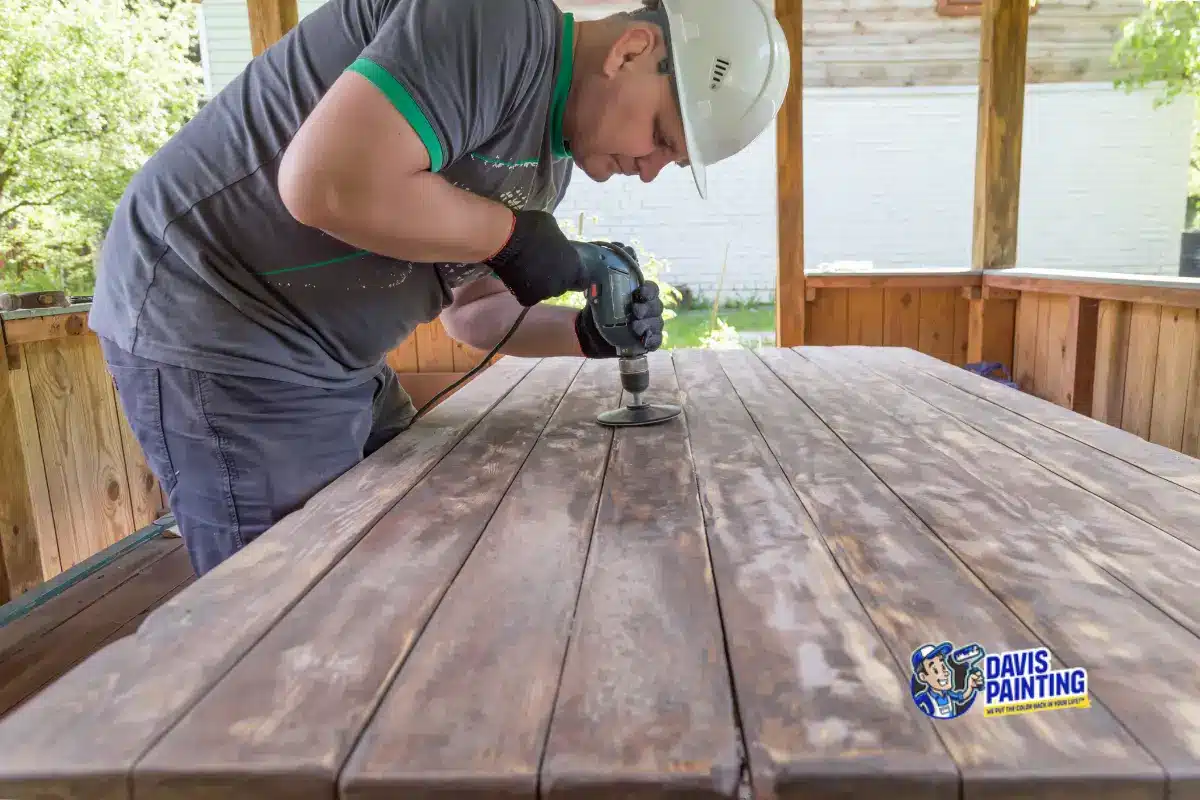
Professional deck staining from Davis Painting in Pennsylvania starts with a pressure wash to remove dirt, algae, and surface greyness, followed by light sanding of raised grain and rough spots, a wood brightener application to restore the natural pH of the wood surface, and the application of the specified stain product at the correct spread rate and in the correct weather window. The preparation phase is what separates a professional deck staining result that holds for three to five years from a DIY application or a crew that rolls stain onto a dirty, unprepared deck.
Here is why each preparation step matters. The pressure wash removes organic growth and surface contamination that is invisible to the naked eye but prevents stain penetration, stain applied over algae or contaminated wood sits on the surface instead of penetrating the fibre and lifts within months. The wood brightener step restores the pH balance of weathered wood, because alkaline wood surface from pressure washing or weathering accepts stain unevenly without it. Even the weather window matters: stain should not be applied to a wet deck or when rain is forecast within 24 hours, and should not be applied in direct sun on very hot Pennsylvania summer afternoons because the surface dries before the stain can penetrate.
The finished result from a properly prepared professional application looks noticeably different from a DIY application. The colour is even across all surfaces. The grain shows through consistently on semi-transparent applications. There are no lap marks or uneven penetration patches at board edges. And the result holds that appearance for the full expected lifespan rather than showing uneven wear within the first season.
For Pennsylvania homeowners looking for deck staining services they can rely on, the Davis Painting about page covers the company’s background and approach. If colour and finish selection is part of the decision, the design tools on the Davis Painting website are a practical way to work through stain colour options before the crew arrives.
How often does a Pennsylvania deck need professional staining, and what shortens or extends that interval?
For most Pennsylvania decks, semi-transparent stain needs professional reapplication every two to three years, and solid stain every three to four years. The factors that shorten that interval are south-facing sun exposure, high daily traffic, pressure-treated pine (more porous than cedar), and deck placement in shade that stays damp between rain events. The factors that extend it are cedar or hardwood construction, covered portions that reduce direct weathering, lower traffic, and quality preparation on the original application. A deck that was properly stripped, brightened, and stained by a professional crew consistently outlasts one that had stain rolled over unprepared wood regardless of the product used.
The question of whether to stain or paint a Pennsylvania deck comes down to one core consideration: what does the wood need, and what maintenance cycle can you commit to over the next ten years? For most natural wood decks in Pennsylvania in 2026, professional deck staining is the right answer. It performs better in the freeze-thaw cycle, fails more gracefully when it reaches the end of its lifespan, and costs less to maintain over time because reapplication does not require stripping. Deck painting makes sense in specific situations, a deck with existing paint that the homeowner wants to refresh rather than strip, or a solid colour preference that solid stain cannot achieve in the desired tone.
Davis Painting offers free deck assessments across Pennsylvania, starting with an honest look at the deck’s condition and treatment history before any recommendation is made. If you want a straight answer for your specific deck before the next season’s maintenance window opens, reach out at davispainting.com.