Davis Painting provides professional power washing services across Pennsylvania as part of every exterior painting project, treating surface preparation as the first and most technically consequential step in a paint job expected to last the full term of its warranty. Power washing before painting in Pennsylvania is not a premium add-on or a line item that ambitious contractors include to pad a quote it is the step that determines whether the paint bonds to the substrate correctly, and skipping it on a Pennsylvania summer job is one of the most reliable ways to produce a finish that fails within two to three seasons rather than the seven to ten years a quality exterior repaint should deliver.
Here is the practical version of why this matters. You get two quotes for an exterior repaint. One includes power washing as a line item. One does not, and it is several hundred dollars cheaper. Both contractors seem competent enough on the phone. The question you are actually trying to answer is whether the cheaper one is being efficient or whether they are setting you up for a paint job that will start peeling before the warranty period is halfway through.
This article answers that question specifically, with the technical reason behind it rather than a general claim about preparation standards.
In this article:
What actually happens when exterior paint is applied to a surface that has not been power washed?
When exterior paint is applied to a surface that has not been properly cleaned, the paint bonds to the contamination layer chalk, algae, mildew, dirt, or oxidised old paint rather than to the substrate itself, meaning the paint film is only as stable as the contamination it is sitting on. On a Pennsylvania home exterior that has been through a full summer and winter cycle, that contamination layer is significant enough that paint applied over it without power washing first will begin separating from the surface within one to two seasons, regardless of the quality of the paint product used.
Most homeowners who have experienced exterior paint failure faster than expected assume it was a product quality issue. In the majority of cases on Pennsylvania homes, it was a surface preparation issue. The paint itself was fine. What failed was the bond between the paint and the surface, and that bond is only as good as what the paint was applied to.
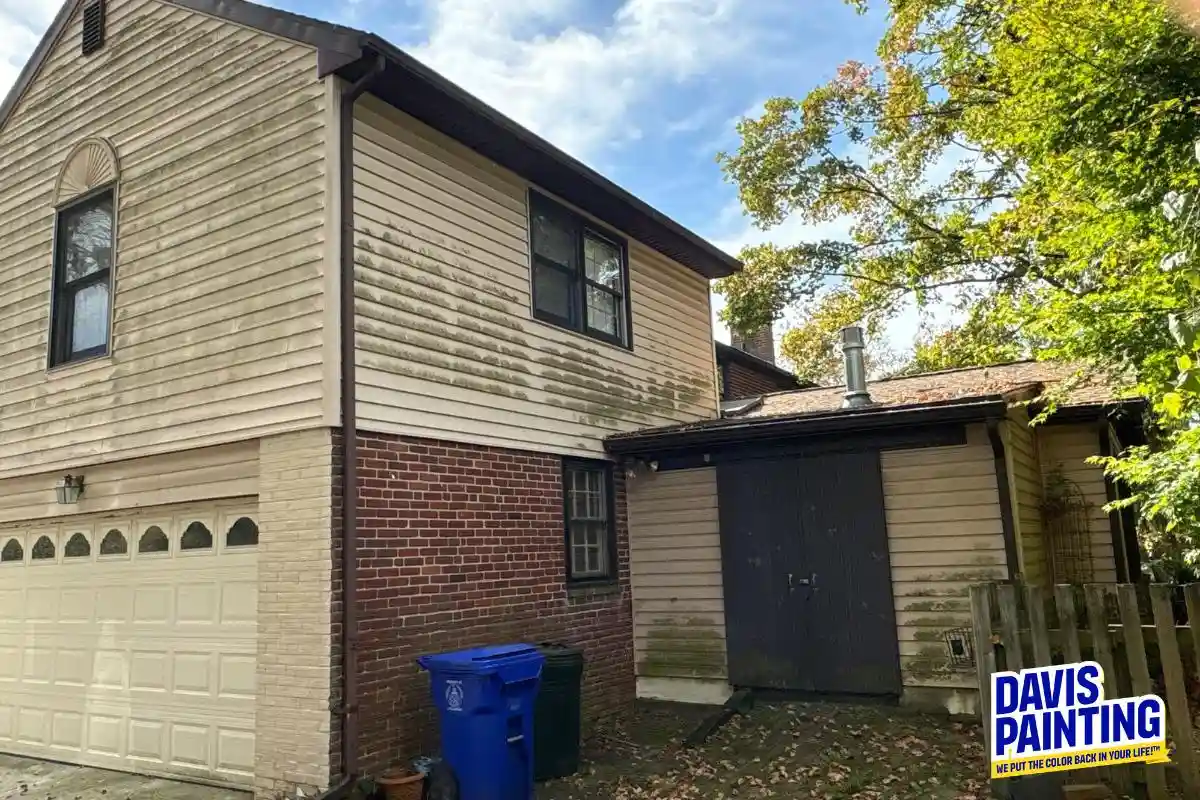
Take a specific and common example. A Chester County colonial with vinyl siding that has been through two Pennsylvania summers. The surface looks clean to the naked eye standing at the driveway. But at close range and at the right light angle, there is chalking from the previous paint coat breaking down under UV exposure, a film of biological growth that is invisible until conditions are right to see it, and a thin layer of atmospheric deposits from traffic and pollen.
A painter who rolls new paint over that surface without washing it first is effectively applying paint over a layer that has no structural connection to the siding itself. The new paint bonds to the contamination. The contamination eventually releases from the siding. The paint comes with it. The homeowner calls it paint failure. The technically accurate description is adhesion failure from inadequate surface preparation.
Does the quality of the paint make a difference if the surface preparation is inadequate?
No, and this point is documented by the paint manufacturers themselves rather than being a contractor opinion. Major paint manufacturers including Sherwin-Williams publish explicit exterior surface preparation requirements that must be met before their products are applied, and their warranty documentation specifically states that improper surface preparation voids the warranty on the paint system. This means that a contractor who applies a premium paint product over an inadequately prepared surface has not given the homeowner a premium result they have simply spent more on a product that will fail at the same rate as a cheaper one would on the same poorly prepared surface. The preparation standard is the foundation. The paint product is what sits on top of it.
Why does Pennsylvania summer weather make surface contamination worse before a paint job than most other climates?
Pennsylvania summers combine high humidity, a significant pollen and organic load from mature tree coverage, and extended periods of moisture retention on exterior surfaces that create ideal conditions for mildew and algae growth on siding, trim, and masonry. These biological contaminants are often invisible in direct light but present in quantities that prevent proper paint adhesion, and the period from late May through August in Pennsylvania is when they accumulate fastest, which is also when most exterior painting projects are scheduled.
The timing creates a specific problem that homeowners in drier climates do not face to the same degree. A homeowner in Arizona scheduling an exterior repaint in June is working with a surface that dried out significantly over the winter and spring. A homeowner in Chester County scheduling the same project in June is working with a surface that has been under elevated humidity conditions for months, and that has been collecting biological contamination since the first warm days of April.
The specific conditions that matter in Pennsylvania summers
Relative humidity in Pennsylvania regularly exceeds 80 percent during July and August mornings across most of the state, keeping exterior surfaces damp for extended periods each day and creating the exact conditions that mildew spores need to germinate on siding and trim. The mature hardwood tree coverage across most of Chester, Bucks, and Montgomery counties also deposits a significant pollen and organic material load on exterior surfaces through spring and early summer. By the time a homeowner schedules an exterior paint job in June or July, those surfaces have been collecting contamination for three to four months without any of it being visible from the ground. A power wash removes that accumulation entirely. Paint applied without it is sitting on a full season of biological growth.
How does mildew on exterior siding affect paint adhesion specifically?
Mildew and algae cause adhesion failure in two specific ways. First, they are hydrophobic; they repel water-based paint products rather than accept them, which means paint applied over active biological growth does not bond evenly across the surface. The areas with the highest concentration of growth are the first areas where paint separates, which is why mildew-related paint failure often shows up as a pattern across a surface rather than random peeling. Second, mildew that is painted over rather than treated and removed continues to grow beneath the new paint film, expanding the zone of poor adhesion from inside the paint system rather than just sitting beneath it. Painting over mildew without treating it first is not a solution to a contamination problem; it accelerates the failure on the exact surfaces that need the most attention.
What does a proper pre-paint power washing service actually include and how does it affect how long the paint lasts?
A proper pre-paint power washing service includes cleaning at appropriate pressure for the specific surface material, a mildewcide or biocide treatment on areas with biological growth, a thorough rinse removing all cleaning agent residue before any primer or paint is applied, and sufficient drying time for the surface to reach the moisture level specified by the primer manufacturer before coating begins. Davis Painting includes this preparation sequence as standard on every exterior painting project in Pennsylvania, not as an optional extra but as the non-negotiable foundation of a paint job that performs to its full expected lifespan.
The reason this sequence matters at every stage is that each step addresses a specific failure point, and skipping any one of them leaves the corresponding failure point unaddressed.
Pressure settings and surface compatibility
The pressure setting varies by surface material because different materials have different tolerances. Vinyl siding, wood, masonry, and brick all require different maximum pressures, and the wrong setting on the wrong material damages the substrate before a single drop of paint is applied. Wood that is hit with pressure appropriate for concrete can have its grain raised the surface fibre structure opens up, creating a texture that holds moisture and dirt more readily than the original surface. That damaged wood is then a worse substrate for paint than it was before anyone picked up a hose.
Biocide treatment for biological contamination
Areas with visible mildew or algae require a biocide treatment that kills the growth at the root rather than just displacing the visible surface material. Pressure alone washes the visible growth away but leaves the root structure in the substrate where it can regenerate within weeks, particularly in Pennsylvania summer humidity conditions. The biocide treatment changes this outcome because it neutralises the biological material rather than moving it. By the time the surface is rinsed and dried, the biological contamination is gone at the root level rather than temporarily absent.
How does pressure washing differ from soft washing before a paint job?
Pressure washing uses high-force water to remove contamination physically. Soft washing uses lower water pressure combined with a cleaning agent that breaks down the contamination chemically before the rinse. For most pre-painting preparation on Pennsylvania residential homes, a combination of both approaches is appropriate: pressure washing on concrete, brick, and masonry where the surface can absorb the force without damage, and soft washing with biocide treatment on vinyl siding and painted wood surfaces where standard pressure washing could damage the material. Our power washing services use both techniques depending on the surface, with the selection made at the site assessment stage rather than applied uniformly across a full exterior.
How long after power washing should you wait before painting in Pennsylvania summer conditions?
Most paint manufacturers specify a minimum of 24 to 48 hours after washing before primer is applied, but this number assumes average atmospheric conditions. In Pennsylvania summer humidity, where morning relative humidity is consistently above 70 to 80 percent, the effective surface moisture content often remains above the primer manufacturer’s specification threshold for longer than the label suggests, because ambient moisture continues to condition the surface even after the visible water has evaporated. A professional painting crew resolves this by monitoring surface moisture with a moisture meter before priming rather than relying on elapsed time alone. The meter reading tells you what the surface actually is, not what it theoretically should be based on the time since washing. This is the difference between applying a paint system correctly and applying it with optimism.
The Prep Is the Paint Job
The homeowner who takes the cheaper quote that skips power washing is not saving several hundred dollars. They are borrowing several hundred dollars against a paint job that will need to be redone significantly earlier than one that was properly prepared. The adhesion chemistry is straightforward and the Pennsylvania summer conditions that make inadequate preparation so consequential are not going to change. A paint job that starts with a thorough power wash, a proper biocide treatment, a complete rinse, and a verified dry surface before any primer touches it is a paint job built on something solid. A paint job that skips that sequence is built on whatever happened to accumulate on that exterior over the previous twelve months.
Davis Painting handles the full preparation-to-completion sequence on residential painting projects across Pennsylvania, with power washing included as standard rather than optional. If you are planning an exterior repaint and want to understand exactly what the preparation on your specific home should look like, reach out at davispainting.com for a free estimate that starts with a site assessment rather than a number over the phone.