Davis Painting is a licensed exterior painting specialist serving Pennsylvania homeowners across the state, offering residential and commercial exterior painting services with application processes specifically calibrated to the humidity and temperature windows that determine how long exterior paint takes to dry and cure correctly in Pennsylvania summers. The question of how long exterior paint takes to dry in summer is more specific than most product labels suggest because dry time and cure time are different things, and Pennsylvania summer humidity affects both in ways that most homeowners do not account for when planning their coating schedule.
Here is the moment that sends most people into this search. The first coat of exterior paint went on yesterday morning. It looks dry. It feels dry. The question is whether the second coat can go on today, and whether the thunderstorm in the afternoon forecast changes anything. The label says two to four hours between coats. A contractor who has done hundreds of exterior painting jobs in Pennsylvania in July and August knows that the label answer and the correct answer for your specific conditions are often not the same number. This article explains the difference and gives you a framework for making the right timing decision.
In this table:
What is the difference between exterior paint dry time and cure time and why does it matter for your project?
Exterior paint dry time refers to how long before the surface is dry to the touch and a second coat can be applied without lifting the first typically two to four hours for most quality latex exterior paints under ideal conditions. Cure time refers to how long before the paint has fully hardened and bonded to the substrate, reaching its rated durability, washability, and weather resistance typically 14 to 30 days for most exterior latex products. A coat of exterior paint that is dry to the touch is not cured, and exposing it to rain, physical contact, or temperature extremes before the cure period ends can compromise the finish even when it looks and feels intact.
Most homeowners use dry time as their only benchmark because it is the number on the label and the threshold they can verify with their fingertip. Cure time is invisible and largely unknown to most people who have not worked professionally with exterior paint products. Understanding the distinction is the single most useful piece of information for anyone planning a residential exterior repaint in Pennsylvania.
Dry time: the surface milestone most homeowners use as the only benchmark
Dry time is the point at which a surface film has formed and touch contact will not mark the finish. For standard exterior latex in reasonable conditions 77 degrees Fahrenheit, 50 percent relative humidity touch-dry happens within one to two hours and recoat-ready happens within two to four hours. These are the numbers on most labels and the numbers most homeowners treat as the complete timing guide. The problem is that they are baseline conditions, and Pennsylvania summer mornings are frequently outside that baseline in ways that extend the timeline significantly.
Cure time: the chemical completion process that most homeowners do not know exists
After the surface film forms, exterior paint continues to cross-link and harden for 14 to 30 days. During this window the paint has not yet reached its rated hardness, washability, or resistance to weather events. A finished-looking exterior repaint that passed touch inspection a week ago is still in a vulnerable phase where direct contact with a pressure washer, a heavy sustained rain event, or repeated physical scraping can affect the finish. Professional exterior painting specialists schedule post-project activities around this window not washing the car against the freshly painted fence, not staging furniture against a newly painted porch wall within the first two weeks, not scheduling a window cleaning service that would pressure-wash the frames before the cure period ends.
Why the distinction matters specifically for applying the second coat
A homeowner who applies the second coat before the first has genuinely reached the dry-for-recoat threshold creates a trapped-moisture condition between layers. On a low-humidity day, that threshold might be two hours. On a Pennsylvania morning in August with 80 percent relative humidity, the same product on the same surface might need four to six hours. Applying the second coat at two hours in those conditions traps solvent or water between layers, and the result shows up as bubbling, wrinkling, or adhesion failure within the first season rather than the seven to ten year lifespan the product is rated for. According to the Sherwin-Williams exterior surface preparation and application guidance, surface preparation and correct application timing are the two most significant factors in exterior paint performance more consequential than the product tier chosen.
How does Pennsylvania summer humidity affect exterior paint drying time and how is it different from what the label says?
In Pennsylvania summers, where relative humidity regularly exceeds 80 percent during morning and evening hours in July and August, exterior paint takes significantly longer to reach the dry-for-recoat threshold than standard label guidance suggests, often two to three times longer than the stated dry time on low-humidity days. High humidity slows the evaporation of water from latex paint, extending both the dry time and the cure period, and a coat of exterior paint that appears dry on the surface may still be releasing moisture for significantly longer than the label implies in typical Pennsylvania summer conditions.
Most exterior latex product labels state dry times based on 50 percent relative humidity and 77 degrees Fahrenheit. Pennsylvania summers regularly produce conditions significantly outside that range during the morning hours, which is precisely when many homeowners and crews begin painting. This is not a subtle variable. At 80 percent humidity, the dry-for-recoat time on a product rated at two hours can legitimately be four to six hours. At 90 percent humidity, some products simply should not be applied at all, because the moisture in the air will interfere with the film formation process in ways that cannot be corrected later.
Morning humidity windows in Pennsylvania and why timing the first coat matters
Morning humidity in Pennsylvania typically peaks between 6am and 10am during summer months, often reaching 80 to 85 percent in eastern and central counties. This is the period most homeowners and many crews start painting because the temperature is still in the comfortable application range. The counterintuitive result is that early-morning exterior painting in Pennsylvania frequently means slower drying on the first coat than painting at 11am on the same day, when humidity has dropped. The optimal application window for most Pennsylvania summer days is between 10am and 2pm, when humidity has fallen and surface temperatures are still within the acceptable application range.
What happens when exterior paint meets rain before it is ready
Pennsylvania summer afternoon thunderstorms are common, particularly from June through August. A latex exterior paint that encounters rain before reaching the minimum dry-for-recoat threshold will wash off, blush (develop a milky or matte surface film), or show water spotting that requires sanding and recoating. The standard guidance is no rain within 24 to 48 hours of exterior paint application. In a Pennsylvania summer with typical storm frequency, checking a multi-day forecast before scheduling any residential exterior painting project is genuinely important rather than optional. Scheduling around a guaranteed dry window is the difference between a finished job and a job that needs to be partially or fully redone.
Does heat help exterior paint dry faster in Pennsylvania summers?
Moderate heat does accelerate drying, but the relationship is not linear and it reverses at higher temperatures. The ideal air temperature range for exterior latex application is 50 to 85 degrees Fahrenheit, with surface temperatures kept below 90 degrees. In that range, warmer conditions do mean faster drying. Above 90 degrees surface temperature which south and west-facing walls in Pennsylvania regularly hit by mid-morning in July and August exterior paint skins over faster than it can level, leaving visible brush marks or roller texture baked into the surface. The optimal approach on hot Pennsylvania summer days is to apply paint to sun-facing surfaces before 11am and focus afternoon work on shaded or north-facing surfaces where temperatures remain in the acceptable range.
What are the ideal conditions for exterior paint application and how does Davis Painting schedule around Pennsylvania summer weather?
Ideal conditions for exterior paint application in Pennsylvania are: air temperature between 50 and 85 degrees Fahrenheit, surface temperature below 90 degrees, relative humidity below 70 percent, no rain forecast within 48 hours, and no direct sun on the surface during application. Davis Painting schedules exterior painting projects around Pennsylvania weather forecasts and monitors conditions on the day to confirm the application window is appropriate before any coating begins because applying exterior paint in the wrong conditions produces results that fail early regardless of the quality of the product used.
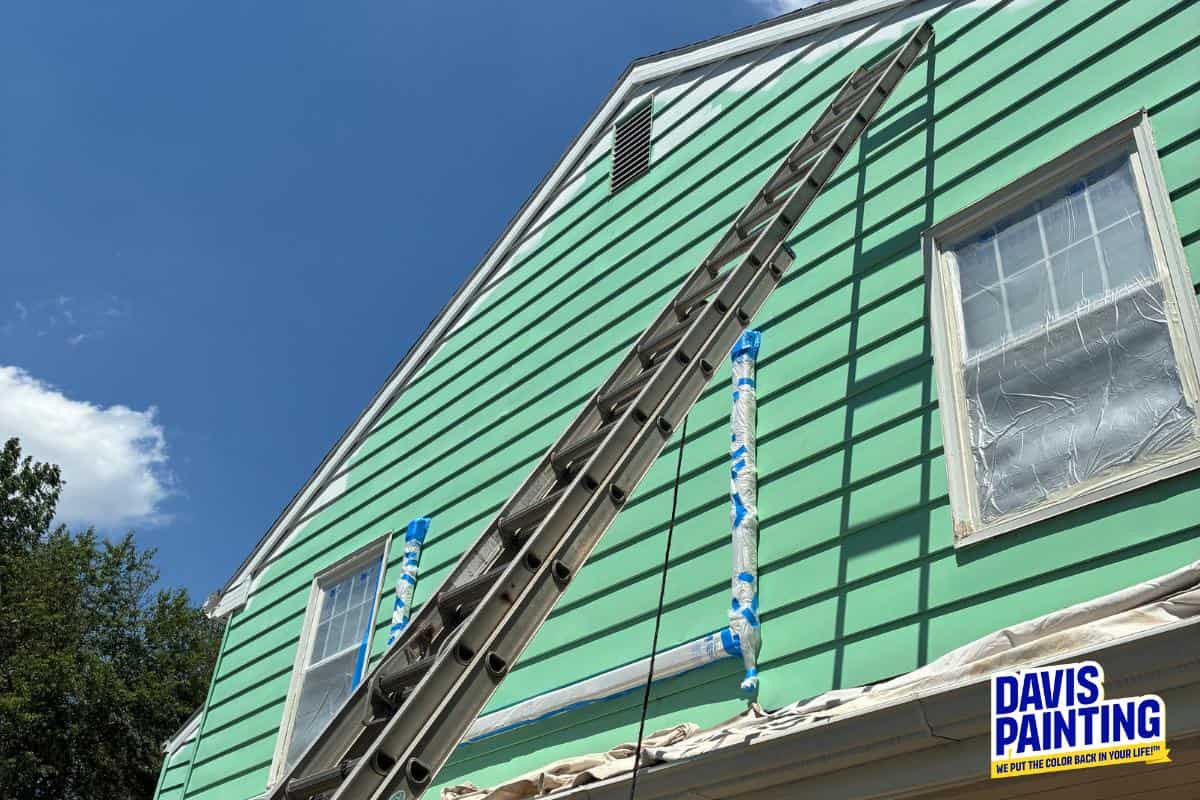
Here is what that process looks like in practice. The forecast is reviewed two to three days before an exterior job is scheduled, and the start time is built around the day’s humidity and temperature arc rather than simply showing up at 8am. On the day, surface conditions are assessed before the first coat begins. Work on south and west-facing surfaces happens in the morning window, before surface temperatures climb past the safe application range. Work on shaded or north-facing surfaces can extend into the afternoon on most days. The crew does not apply paint to surfaces that still hold moisture from overnight conditions. The timing between the first and second coat is determined by the actual humidity and temperature on that day not by the label alone, and not by the schedule if the schedule is running ahead of what the conditions support.
How many coats of exterior paint does a Pennsylvania home typically need?
Two coats over a properly primed surface is the standard for most residential exterior repaints. Three coats may be appropriate on surfaces with significant porosity, a major colour shift, or existing adhesion challenges that require additional build to produce a stable finish. The number of coats is less important than the conditions under which each coat is applied and the drying window maintained between them. Two coats applied correctly under the right conditions produce a finish that lasts; three coats applied in the wrong humidity window or without adequate dry time between them produce a finish that fails earlier than one should. To get a written estimate that specifies coat count, prep scope, and a realistic timeline for your specific property, request a free exterior painting estimate from Davis Painting.
How does Davis Painting handle exterior paint drying time on commercial properties in Pennsylvania?
Commercial exterior painting adds a layer of scheduling complexity on top of weather business operating hours, tenant occupancy, site access, and aesthetic consistency requirements all affect when and how coats can be applied. Davis Painting applies the same weather-monitoring and condition-assessment approach to commercial exterior projects, with the additional coordination required to work around occupied properties. The result is that commercial exterior painting schedules are built to be realistic from the start rather than optimistic, with weather contingencies planned rather than hoped against.
The Right Conditions Make the Difference Between a Paint Job That Lasts and One That Does Not
A homeowner who knows the difference between dry time and cure time, understands how Pennsylvania summer humidity extends both, and plans their coating schedule around the actual conditions on the day is a homeowner who gets the full lifespan from their exterior paint investment. The same information applies whether you are doing the job yourself or evaluating a contractor’s approach. A crew that checks surface temperature and humidity before starting, times the recoat window to actual conditions, and schedules around the rain forecast rather than hoping for the best is a crew whose work holds through a Pennsylvania winter.
Davis Painting provides home exterior painting services across Pennsylvania with written estimates that include prep scope, material specifications, and a realistic weather-aware timeline. If you are planning an exterior project this summer, reach out for a free estimate and find out what the right conditions and the right process look like for your specific property.