Davis Painting provides historical restoration painting services across Pennsylvania, working with homeowners on pre-1940 properties, designated historic district homes, and architecturally significant buildings to ensure that every paint application meets both preservation standards and the visual integrity of the original structure. Painting historic homes in Pennsylvania involves navigating local preservation board requirements, selecting period-appropriate paint colours that align with the Secretary of the Interior Standards for Rehabilitation, and using materials and preparation methods that protect historic surfaces rather than compromising them.
The moment most historic home owners realise this project is different from a standard repaint usually comes somewhere between opening a paint catalogue and getting a call back from their municipality. You want to repaint the exterior. You have a colour in mind. And then someone mentions the Historic Architectural Review Board, and suddenly the timeline you had in your head looks different. This is not unusual. It happens to most people who own property in a designated historic district in Pennsylvania, and it happens because the rules exist to protect the architectural character of communities that have invested significantly in their historic status. Understanding those rules is the first step, and it is more manageable than it sounds.
In this article:
What rules actually apply when you paint a historic home in Pennsylvania?
The rules that apply to painting a historic home in Pennsylvania depend primarily on whether the property is in a locally designated historic district, listed on the National Register of Historic Places, or subject to deed restrictions or HOA covenants specific to the community. Properties in locally designated districts require approval from a Historic Architectural Review Board before exterior painting begins, and that approval is based on the Secretary of the Interior Standards for Rehabilitation and local design guidelines that specify acceptable colour ranges, finish types, and material approaches.
Most homeowners come into this question with one of two misconceptions. Either they assume that because their house is on the National Register, they need federal approval for everything. Or they assume that because their house is just old and not officially designated, they can do whatever they want. Neither is exactly right, and the actual answer depends on something more specific: whether your property falls within a locally designated historic district boundary.
1. Local historic district designation and HARB approval
A Historic Architectural Review Board, or HARB, is the body that governs exterior changes including painting in most Pennsylvania municipalities that have established a local historic district. If your property is within that boundary, you need HARB approval before exterior work begins. The approval process involves submitting colour and material samples, and the review timeline varies significantly by municipality. Chester County, Bucks County, Lancaster, and many Philadelphia-area townships all operate active HARBs with their own specific design guidelines. The best starting point is your borough or township office, which can confirm whether your address falls within a designated district boundary.
2. What National Register listing actually means for private owners
This is the clarification most homeowners need to hear: being listed on the National Register of Historic Places does not automatically require federal approval for a private homeowner repainting their own home. National Register listing is largely an honorary designation for privately owned properties. It may affect your eligibility for certain tax credits if you undertake a significant rehabilitation, but it does not create a regulatory requirement to seek approval before painting. The regulatory requirement comes from local historic district designation, not from national listing.
3. The Secretary of the Interior Standards as the baseline framework
Most Pennsylvania HARBs base their review criteria on the Secretary of the Interior Standards for Rehabilitation, published by the National Park Service. For painting specifically, these standards require that treatments be reversible where possible, that historic materials not be damaged by the application process, and that new finishes be visually compatible with the historic character of the building. In practice, this means that a bright modern colour on a Federal-period stone facade will likely not pass review, while a historically documented earth tone with a flat finish likely will.
4. HOA and deed restrictions that operate alongside historic designation
Some Pennsylvania historic properties carry deed restrictions or HOA covenants that require colour approval even when no formal HARB exists. These are property-specific and need to be confirmed with the title documentation or the HOA governing documents before proposing any colours. If your property sits within a community that has both historic designation and active HOA governance, our HOA exterior painting services page covers how those dual approval requirements typically get managed within a single project scope.
How do you choose the right paint colours for a historic home without getting rejected by the preservation board?
For Pennsylvania historic homes subject to HARB approval, paint colour selection should start with historically accurate colour systems from major manufacturers and be cross-referenced with the local historic district design guidelines before submission. A contractor experienced in historical restoration painting can confirm which specific colours and finishes have been approved in a given Pennsylvania district before the homeowner submits, reducing the chance of a board rejection that delays the project by a full review cycle.
Colour selection for a historic home is not simply an aesthetic decision. It is a research question. The right colour for your property is the one that is both visually appropriate for the architectural period of the home and consistent with what your local HARB considers historically compatible for the district. Getting that right requires knowing what the district guidelines actually say, not just what looks good on a colour card.
Where to start: historically accurate colour systems
Three manufacturer colour ranges are most widely referenced in HARB approvals across Pennsylvania. Benjamin Moore Historical Colours draws on documented colonial and Federal-period pigment research. Sherwin-Williams Preservation Palette is specifically developed for architecturally significant properties and is frequently referenced in historic district guidelines. Farrow and Ball offers colours derived from historical British and American paint research. All three are more expensive than standard ranges and are worth the investment when the alternative is a board rejection and a resubmission cycle that adds weeks to the project.
Matching colours to the architectural period of the home
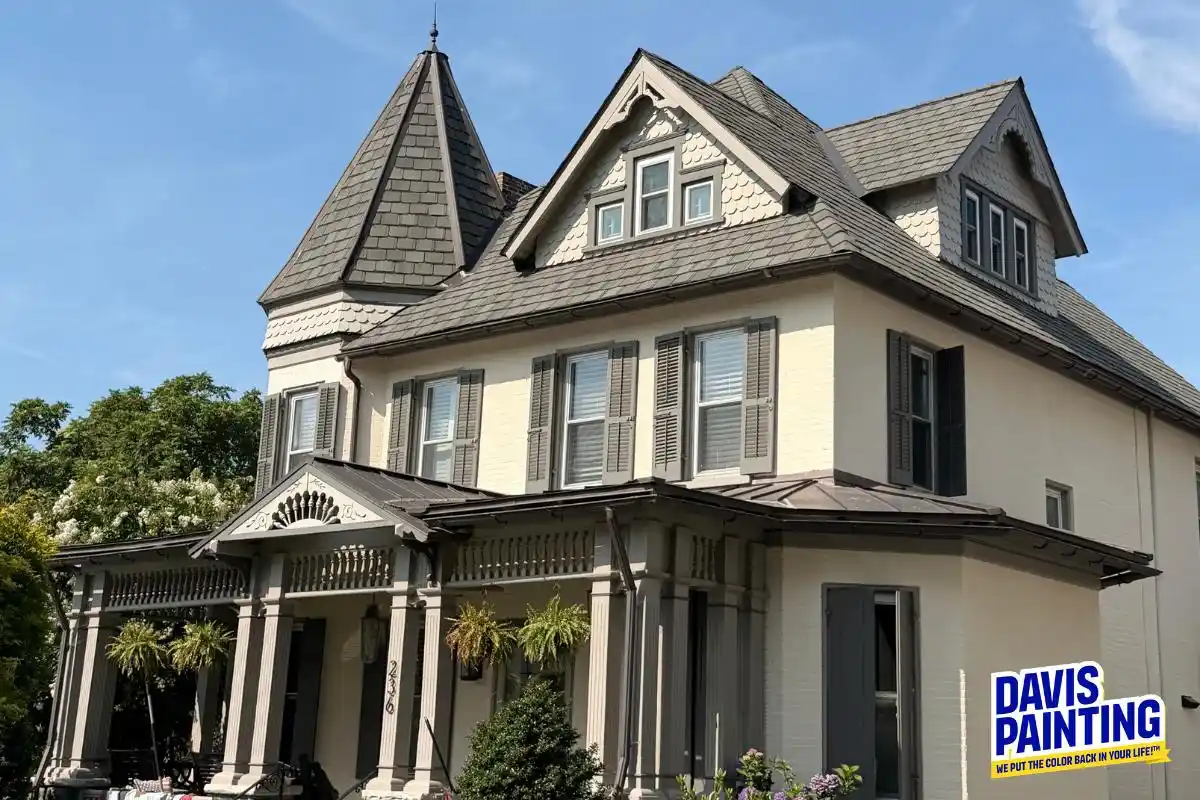
Federal and Greek Revival homes built between roughly 1780 and 1850 used muted earth tones, ochres, and colours derived from natural mineral pigments. Victorian homes from the 1860s through 1900 are well known for their multi-colour schemes with contrasting trim and accent colours on decorative woodwork. Craftsman bungalows from 1905 through the late 1920s used earthy, natural tones that complemented wood, brick, and stone rather than contrasting with them. Understanding which period your home belongs to is the starting point for a colour palette that will read as authentic to a review board rather than anachronistic.
Understanding the HARB submission process for colour approval
Most Pennsylvania HARBs require a written description of the proposed work, physical or digital paint samples, photographs of the existing exterior, and in some cases a site visit before a decision is made. Timelines range from 30 days to a full board meeting cycle depending on the municipality. Working with a contractor who has submitted to these boards before means the submission is formatted correctly the first time, which is a practical difference that affects your project start date.
What paint finishes are appropriate for historic home exteriors?
Flat and low-sheen finishes are the most appropriate for historic wood exteriors and the most commonly approved by Pennsylvania preservation boards. High-gloss finishes were not available during most of the periods represented by Pennsylvania’s historic housing stock, and they create an anachronistic visual appearance that boards consistently reject. For the exterior of a historic home, limewash painting is one of the most historically authentic finish options available and is appropriate for stone, brick, and stucco surfaces where it was originally used. For wood, a flat oil-based or water-based topcoat over a compatible primer is the standard professional approach.
What makes painting a historic home different from a standard repaint and why does the contractor you choose matter?
Painting a historic home requires different preparation techniques, material choices, and documentation than a standard residential repaint, particularly regarding lead paint testing and remediation on pre-1978 homes, the use of historically compatible primers and topcoats rather than modern acrylic systems, and the ability to provide HARB-ready documentation for the board submission process. Davis Painting’s historical restoration painting services in Pennsylvania are specifically built around these requirements, not retrofitted from a standard exterior painting process.
The practical differences show up at every stage of the project. A general painter who has not worked on historic properties before may use power tools for surface preparation on original millwork where hand scraping is the correct approach. They may apply a modern acrylic primer over aged oil-based paint on original clapboard without addressing the adhesion incompatibility that will cause the topcoat to fail within the first winter freeze-thaw cycle. They may not know that the colour they helped you pick needs board approval before it touches the surface.
What is the lead paint process for historic homes in Pennsylvania?
Any Pennsylvania home built before 1978 must be tested for lead paint before you begin any scraping or surface preparation work. Under the EPA Renovation, Repair, and Painting rule, contractors working on pre-1978 properties must hold current EPA RRP certification. This is a legal requirement, not a recommendation. Hiring a contractor without this certification to work on a lead-positive historic property creates both a health risk from improper lead dust containment and a legal liability for the homeowner. Davis Painting requires EPA RRP certification for all historical restoration work on pre-1978 properties across Pennsylvania.
What does a full historical restoration painting project look like with Davis Painting?
A Davis Painting historical restoration project starts with an on-site assessment of the property’s architectural period, current surface condition, and whether the project falls within a locally designated historic district. If HARB approval is required, we support the submission process including colour documentation and sample preparation. Lead paint testing is completed before any preparation work begins on pre-1978 properties. Preparation uses hand scraping and historically appropriate priming rather than modern power tool methods that can damage original millwork. The topcoat application follows the colour and finish specifications in the approved submission. Final documentation is provided to the homeowner for any future board reference. The historical restoration services page is where the conversation begins, and more about Davis Painting’s Pennsylvania background and experience is on the about page.
Your Historic Home Deserves a Painter Who Has Done This Before
Painting a historic home in Pennsylvania in 2026 involves more steps than a standard repaint. The rules are real, the approval process is specific to your municipality, and the materials and preparation methods matter in ways that affect how long the result holds and whether it survives a board review. None of that is a reason to put the project off indefinitely. It is a reason to start the conversation with a contractor who has done this before, who knows what the board needs to see, and who has the certification and the material knowledge to do the job correctly from the first day on site.
Davis Painting provides residential historical restoration painting across Pennsylvania with specific experience in HARB submission support, period-appropriate colour selection, and historically compatible material systems. Visit davispainting.com for a free estimate that starts with an honest assessment of what your property actually needs.